Roussillon 'French Catalonia' wine book

"Order my book on the Roussillon direct saving £4/€4 (UK & EU only) or download the Kindle eBook on Amazon UK . Buy it in the USA ...

Search WineWriting.com:

30 March 2013

Italy: Tuscany - San Polino, Brunello di Montalcino

According to their site, Luigi Fabbro, Katia Nussbaum and family practise "permaculture and biodynamic-organic farming..." at their four hectare estate (10 acres divided roughly into two thirds / one third of vines and olives, which are made into their own extra-virgin olive oil) up in the pretty Montalcino hills. I've never seen or heard the former term used by a winery before, which apparently implies an element of sustainable design or building within a self-sufficient and environmentally friendly farming model (man). The vineyard is planted entirely with the Sangiovese grape, and their first Brunello, as they call this variety here or rather the local 'clone' of it, was released in 2001 following several years of restoration and replanting work between 1991 and 1998. Winemaker and viticulturist Alberto Gjilaska, originally from Albania, has been on the team since those early days. Importers include Integrity Wines in the US, Vintage Roots (£ prices below) and Dynamic Vines in the UK; € prices quoted are approx. cellar door. So, chill out and enjoy the view (copied from www.sanpolino.it)!


2011 Sant Antimo Rosso di Montalcino - lovely fruity vs 'inky' red with dark morello cherry flavours, easy going and tasty. €7
2008 Brunello di Montalcino - light toasted coconut tones, rich vs firm palate, quite extracted and chewy yet has nice tannins and plenty of ripe 'sweet/savoury' fruit, some fresh acidity lingering too on its balanced long finish. €20 £27-£30
2008 Brunello di Montalcino Helichrysum - perfumed floral wild herb and minty notes vs dried fruits, attractive maturing fruit yet still firm and dry mouth-feel, tasty concentrated 'sweet/savoury' finish. €30 £52
2007 Brunello di Montalcino Riserva - similar profile but more developed and softer, lovely dried fruits with meaty edges, still structured with subtle concentration but riper tannins and long finish.

29 March 2013

Burgundy: Les Champs de l'Abbaye, Côte Chalonnaise

Photo from www.rawfair.com
Alain and Isabelle Hasard (which means chance or coincidence in French, appropriately perhaps as I did indeed just happen to stop by at their table at Millésime Bio organic wine show a few weeks ago in Montpellier, France) own a few little vineyards in different sites in the Côte de Beaune and (mainly) Côte Chalonnaise (the latter being that chunk roughly in the middle of Burgundy's wine-lands, between the Beaune and Macon vineyard areas). They're based in the hilltop village of Aluze - and have two vineyards here called Clos de Roches and Les Gardes - which lies to the southwest of Rully where they have one plot called Les Cailloux, and slightly northwest of Mercurey where they own two more sites called La Brigadière and Les Marcoeurs. Les Sous Roches in Monthélie (between Volnay and Meursault) completes the Hasard family's patchwork picture; and they also make sparkling wine in addition to the whites and reds sourced from the aforementioned appellations. They've been certified organic - or rather their vineyards have! - since 1999 and are "inspired by biodynamics." I like their nice and simple explanation of organic farming and why they do it: "It teaches us to search for the origins of problems that may arise rather than simply treat the consequences, and to establish harmony rather than fight against it." Otherwise, it looks like their winemaking is pretty traditional and towards 'minimal intervention' (to use a rather overused cliché) for both reds and whites, which in general are aged in 25% to 50% of new oak barrels, "because our wines are so concentrated," as it says modestly in their profile blurb! These are bottled "without fining and filtration... our wines are living products." Here's what I thought of them then:

2010 Rully blanc Les Cailloux (Chardonnay) - enticing creamy vs citrus fruit with a touch of toasted oak, quite subtle and elegant with fresh acidity vs some weight too; still a bit closed up, quite fine and needs more time.
2011 Rully blanc Les Cailloux (Chardonnay) - more aromatic with nutty and peachy fruit, more forward than the 2010 and a touch richer and more buttery already, showing subtle toasty notes vs freshness too. Attractive now actually.
2011 Mercurey blanc La Brigadière (Chardonnay) - a tad richer and fuller with peachy vs toasty flavours, again it's quite delicate and tight on the palate, promising though.
2011 Mercurey rouge La Brigadière (Pinot Noir) - subtle red fruits with lightly funky edges, juicy and soft with a little grip and elegant fresh acidity. Nice wine, drinking well now.

Raeburn Fine Wines (Edinburgh and London) imports their range into the UK, priced at £21.50-£22.50 for some of the wines tasted above or earlier vintages; Leon Stolarski also expressed an interest in them on his blog following a trip there. They cost about €15-€20 cellar door; and you can get some of them in Dublin too according to www.sourgrapes.ie (from about €15). They export to "the US and Far East..." as well, Alain told me at the fair: contact him on alainhasard@wanadoo.fr for more details.

26 March 2013

Rhône: Châteauneuf-du-Pape wine fair 6-7 April

This seasonal Grenache-tastic wine event, called 'Les Printemps de Châteauneuf-du-Pape' ("Springtime for..." I won't carry on singing the words to this inappropriate number from a famous Mel Brooks' film, but that's the way my drifting mind works sometimes, especially as it's still winter here: answers on a postcard blah...), will feature over 80 estates and wineries and takes place on 6th and 7th April. Sounds like a good idea! More info: lesprintempsdechateauneufdupape.fr

Recent Châteauneuf on this blog: World Grenache Competition part 2.
See side bar links for more (Southern Rhone Valley Page).

Roussillon: Le Scarabée, Sorède


This bijou-scale vineyard lies a couple of kilometres from the sea in different spots along the sometimes brooding sometimes radiant Albères hills, which draw the Fauviste border with Spain in the southeastern chunk of the Pyrénées Orientales. Treated organically since the beginning of her adventure in 2007, which owner-grower-winemaker Isabelle Frère admits is time-consuming “intensive” work, since certain of her plots of mostly old vines were “virtually abandoned” and “knew only (synthetic) herbicides and fertilisers for almost all of their life.” This is why she's made a “difficult choice” to focus on one parcel each year to “do the full works on,” as it's very labour-intensive. Good to see there are some EU grants available though to encourage growers to go the extra kilometre required to convert to organics, around 350 Euros per hectare apparently, even if this “doesn't help much.”
As for varieties planted, two-thirds of the Carignan in Le Scarabée (a kind of beetle by the way), or about 2000 vines, is 80 years old, which is tilled by horse and Isabelle says she has “a bit of a soft spot for.” This is used for the Murmûre label, while the other 0.5 hectares, 20 to 70 years old, tops up Volubile, Le P’tit Scarabée red and Sur un nuage. These are found near the village of St André between Argelès and Sorède, where the cellar is. There's also 1 ha (2.47 acres incidentally) of 10 year-old Grenache rubbing trunks with the Carignan here, as well as a small 40 year-old parcel to the west near Laroque–des-Albères, “on loan from a retired grower... this has always been ploughed.” This helps beef up Isabelle's Sur un nuage and Murmûre cuvées.
You'll find about 1 hectare of the 'grey' Grenache variety too, some of it mixed in with the Carignan (that's how they originally planted in the old VDN field-blend days), which livens up Le P’tit Scarabée rosé. There's a small amount more 70 year-old gris in the sandy St André area, which goes into red P’tit Scarabée and La folie Juvénile, as well as some 40 year-old found just west of here near St. Genis des Fontaines, which lurks around in a little Macabeu vineyard destined for Isabelle's Pied’nez white wine.
The Syrah is similarly parcelled into three plots in the St. André zone: one is the source for P’tit scarabée rosé and red, another - also 20 years old but "less vigorous" - for Volubile and Murmûre; and the third, and largest, a "big problem" parcel of young vines that "came with the lot", which Isabelle green-harvests severely to make La Folie Juvénile, although she hopes it will eventually produce very good grapes. I didn't like all her wines though, but that's life I guess. Les Caves de Pyrène (London area) sells this range for about £10 to £20 a bottle; the wines are available in Canada (Quebec) too hence the CA$ prices. And Isabelle is a friendly person to call in on if you're touring this area: Moli d’en Cassanyes, 66690 Sorède. Mobile 06 14 73 34 80, isabellefrere@hotmail.fr, www.laremise.fr (photo taken from there).

2010 Le Petit Scarabée – nice and easy fruity style with funky smoky and liquorice notes, soft palate with just a hint of dry grip. CA$22
2010 Sur un Nuage – similar profile although shows more depth with lusher vs firmer palate and still has attractive tannins though. CA$25
2011 Murmure – pretty intense, grippy with crunchy blueberry vs lusher darker fruit, savoury rustic edges with nice length though. €16 (France)
2010 Murmure – more developed savoury smoky notes vs concentrated lush cherry fruit underneath, firm and tight mouth-feel still; more closed up than the 11 actually, powerful with good depth and attractive rounded tannins.

21 March 2013

Roussillon: Domaine du Possible, Lansac

Loïc Roure acquired 6½ hectares of vines (16 acres) while taking over the abandoned co-op winery building in Lansac back in 2003, which needed a thorough clean-up and refit with new equipment and now also houses a top-floor apartment and art studio. The first plots he found were/are in Latour-de-France followed by a few more in neighbouring Rasiguères, Bélesta, Cassagnes and Lesquerde; and another four ha were purchased more recently in Caudiès-de-Fenouillèdes a dozen kilometres to the wild west on the Aude frontier.

20 March 2013

Roussillon: Le Bout du Monde, Lansac


Edouard Laffitte was a co-op winemaker in Estézargues (a wee town between Avignon and Nimes) before he bought six or seven disparate hectares of vines at “the end of the world” as he calls it - the name of the estate that is, rather than some mythical spot evoked by Wim Wenders' movie or U2's title song from it - near Lansac, which is found a few kilometres southwest of Maury down the meandering little road heading towards Trilla or Caramany. Edouard has three granite-laden plots here in Lansac in fact - where he shares the former co-op cellar bought by Loïc Roure of Domaine du Possible (profile to follow) - two nestling on that much talked-about flaky schist characteristic of the Rasiguères area (and said to work especially well for Syrah), and nearly two more near Cassagnes a little further south peppered with trickier to pronounce 'gneiss' (“gn...” rather than “nice” I believe: it's a kind of striped metamorphic rock, man). These plots lie at from 150 to 400 metres (500 to 1300 feet) altitude, which helps lend a slightly cooler edge to those hot summer days and nights and hence “limit the alcohol,” as Edouard states is his aim on his website domaineleboutdumonde.sitew.com (where I took the photo from); and the vineyards are organically farmed. Apparently the wines aren't fined or filtered, as is fashionable perhaps in 'natural' circles, but this non-technique doesn't appear to have done any harm to the wines I've tried.
His London area distributor is Les Caves de Pyrène, and the wines are also available from e.g. Ellis Wharton Wines in Cornwall. A US importer is Selection Massale in California. Where to find him in situ: 13 Avenue des Platanes, 66720 Lansac. Mobile 06 77 50 94 22, edouard.laffitte@laposte.net

2011 L'Echappée Belle (Syrah) – peppery and 'inky' with cherry and liquorice notes, fruity palate with soft tannins, nice pure and spicy style.
2011 Tam Tam Côtes du Roussillon (mostly Syrah from schist + Carignan/Grenache) – richer and more intense with more liquorice than pepper flavours, firmer mouth-feel yet still has attractive tannins and tasty youthful fruit. UK £15
2011 Hop' La (Carignan, Grenache, Syrah) – 'tarter' and tighter profile initially with lively palate and nice fruit showing quite dark vs savoury vs spicy finish. US $18
2011 L'Ecume des Jours (Lladoner Pelut, Carignan) – again it's lively and spicy with sweet vs tart fruit mix, less expressive on the finish mingling lush vs bitter twist. Not so obvious. US $19
2011 Avec le Temps (Carignan) – spicy blueberry fruit, fresh bite and length vs sweeter liquorice side, spicy quite intense finish.
2009 La Luce Côtes du Roussillon (mostly Grenache) – more developed with 'volatile' tones, quite rich and concentrated with peppery punchy mouth-feel, attarctive 'sweet/savoury' finish and length.

18 March 2013

Roussillon: Clos du Rouge Gorge, Latour-de-France

Cyril Fhal landed in Latour land over ten years ago, having worked at two small estates in the Anjou and Saumur wine regions, where he became committed to the idea of working organically. He's one of now a dozen organic independent growers in the village (half of them are on this blog) and is known for putting in a good deal of painstaking hours in the vineyard, with the aim of enticing “very pure juice” from his grapes, as he put it. The 'Red Neck' vineyard comes to just six patchwork hectares (15 acres) of old vines (50 to 100 years old) on elevated rocky slopes dotted around Latour-de-France, half of which is senior-citizen Carignan nestling up against Grenache, Cinsault and Maccabeu. Cyril is in the “no or low sulphite” camp, and his wines do have some of those quirky 'natural' winemaking edges; but there's an elegant fresher side to them too with some intriguing tasty flavours. By the way, his 'young vines' red is apparently made from 25 year-old Grenache, which isn't very young in vine terms and perhaps gives you a glimpse of where he's coming from.
These (admittedly rather expensive) wines are available from Vine Trail in the UK - where I borrowed some of this info from, as it seems Cyril is far too busy, or wise perhaps, to have a website, blog or Facebook page; though I did meet him at last year's Real Wine Fair in London. The £GBP prices below are for a mixed case, €uros an average on-line price in France and $ price at Chambers Street Wines, NYC. Going there: 6 place Marcel Vié. Phone: 04 68 29 16 37, cyrilfhal@gmail.com.

2008 white Côtes Catalanes (Macabeu) – nutty appley lightly oxidised style, but this wine is tasty and quite long on the finish with an attractive mix of 'mineral' and rounded sensations. £18.25, €20
2010 Jeunes Vignes red Côtes Catalanes (Grenache) – light rustic-edged red, again has some of those apple/cider tones but is soft elegant and tasty in the end; quite light but it flows, man. Not great value @ £17.85, €18.50.
2007 Vieilles Vignes red Côtes Catalanes (mostly Carignan with Grenache) – similar profile on the nose but more concentrated with lush vs tarter blue fruit characters, grippy fresh palate yet has nice texture and interesting flavours. £23.50, €30, $33

14 March 2013

Languedoc: Clos du Gravillas update

The latest from Nicole and John Bojanowski in St-Jean de Minervois is HERE, including a couple of new-ish wines: a white made from Terret gris and a Fino style based on flor-aged Grenache blanc (original post August 2011 with updates from 2007 to now).

11 March 2013

Grenache: Australia - Seppeltsfield & Kilikanoon

Nathan Waks oiling his cello with
Grenache: kilikanoon.com.au
'Aka further adventures from the World Grenache Competition' held in France a few weeks ago, where I was one of the (many) judges. This time, the limelight neatly shifts continents to Australia and a guy called Nathan Waks in particular, who came over from Oz for the event and brought a few Grenache wines and some interesting stories with him.

07 March 2013

Provence: Château des Launes

2011 Château des Launes white (85% Rolle, 15% Ugni blanc; 13.5% alc.) - aromatic floral and lees-edged, quite intense crisp and fresh with grapefruit vs oily honeyed flavours/texture, has a bit of weight too on its long stylish finish. Approx €11.50 cellar door/on-line (see website below for world distributors).
2011 Château des Launes rosé (75 Cinsault, 25 Grenache; 13%) - delicate and zesty with attractive citrus and rose petal aromas/flavours, crisp mouth-feel with lees-y bite and texture and a little roundness on the finish too. €9.50
2008 Cuvée Thomas red (70 Syrah, 30 Cabernet Sauvignon; 13%) - smoky edges with meaty and dark fruit, firm grip vs ripe and rounded on the palate, structured 'serious' finish with concentrated solid mouth-feel vs smoky maturing fruit. €13
2008 Cuvée Spéciale red (70 Syrah, 30 Cabernet Sauvignon; 13.5%) - more pencil shaving/coconut oak on the nose, rich and solid though with grainy texture, extracted and concentrated layered with lush ripe fruit and firm tannins, then tasty savoury finish too. Again pretty serious wine although quite dear at €19.50 (that's trendy Provence for you, although it's on offer on their site for about €11.75 when I looked, as are some of the others reviewed here).


This pretty estate lies in the Côtes de Provence appellation in the spectacular Massif des Maures national park area, about 10 kilometres inland from Saint Tropez heading towards Le Luc. It was renovated and replanted by the Dielesen family in 2005, who've obviously invested heavily here with a new winery, on-site holiday accommodation and a riding school too: check out www.chateaudeslaunes.com for more on that (I pinched the photo off there by the way). I tasted their wines in London last year.

02 March 2013

Languedoc: Sainte Cécile du Parc update

"Stéphane Mouton and Christine Mouton Bertoli created this new estate in 2005, which is found between Pézenas and the little village of Caux..."
Including the 2009 vintage of two of their Coteaux du Languedoc reds tasting-noted: Notes d'Orphée and Sonatina both made from Syrah and old Cinsault vines.
CLICK HERE to read my updated profile (originally scribbled in May 2010).
More stuff mentioning their wines: HERE (April 2015) and HERE (Sept. 2010).

Wine Education Service courses & tastings March - May

UPDATED 12/3
There are four Wine Education Service NI events scheduled in Belfast city centre over the next few weeks, tutored by RMJ:
'Essential Wine Tasting' 5 week course £125 for five sessions
Rescheduled: Tuesday evenings May 28 and June 4, 11, 18, 25. More details about this course here:
'Classic Grape Varieties' Thursday 28 March 7-9 p.m - £30
NEW! 'Wines of Southern France' Tuesday 30 April - £35
More info on above two tutored tastings HERE (scroll down a little).
One-day wine workshop £85 for the day including lunch - 'Le Tour de France' Saturday April 6. More details about this and other workshops here:
wine-education-service.co.uk/workshop
Full listing of wine tastings and courses running in Belfast to June 2013 and on-line booking are here: www.wine-education-service.co.uk/wine-tasting-belfast

And forthcoming Wine Education Service events at different venues in London, Aberdeen, Brighton and Manchester include:
Five and eight-week introductory courses; intermediate courses on France, Classic Grape Varieties and Italy; special interest courses on Burgundy and Scotch Whisky; as well as a variety of Saturday workshops and evening tutored tastings. Full details of London events are here: wine-education-service.co.uk/course-dates with links to other cities on that page.


01 March 2013

Southern Rhône: +50% Grenache half-dozen

Here's another gratuitous Grenache mini-feature, this time focusing on six or seven Grenache-laden reds (re)discovered at a tasting last year, although these vintages (2010 and 2009, both very good) are probably still on sale. I've picked out a few I thought were pretty typical of the kind of lush spicy sunshine red you'd expect and want from the southern Rhone valley, from widely available to 'specialist merchant' and costing £7 to £15 in the UK.

Les Dauphins Réserve 2010 Côtes du Rhône, Celliers des Dauphins (60% Grenache, 40% Syrah; 13.5% alc.) - nice juicy ripe sweet Grenache fruit with spicy cherry undertones, quite soft and easy-going, attractive style. £6.99 Dedicated Wines (widely available).
Belleruche 2010 Côtes du Rhône, M. Chapoutier (50 Grenache, 50 Syrah; 13.5% alc.) - well-known name and label, this is similar to the above wine although more extracted and firmer, yet layered with nice sweet fruit. £9.50 Mentzendorff.
Les Coteaux 2009 Côtes du Rhône Villages, Boutinot (85 Grenache, 15 Syrah; 14% alc.) - quite rich and spicy with lush liquorice and blackberry fruit, punchy and grippy palate vs plenty of lovely soft dark fruit. £8.90 Boutinot.
Réserve du Crouzau 2010 Côtes du Rhône Villages Saint Gervais, Vignobles Foncalieu (80 Grenache, 20 Syrah; 14.5% alc.) - attractive Grenache nose and palate, rich and ripe vs powerful and peppery, tasty sweet fruit vs grip on its weighty finish. £7.99 The City Beverage Company, Hennings Wine Merchants.
Vacqueyras 2010, Domaine de la Soleiade (55 Grenache, 45 Syrah) - more perfumed and minty even, black cherry and liquorice with smoky edges too, concentrated powerful and firm with delicious ripe fruit. £13.10 Charles Taylor.
Les Pierres du Vallat 2010 Gigondas, Vignerons de Caractère (60 Grenache, 30 Syrah, 10 Mourvèdre14.5% alc.) - showing similar wild herb/minty edges, gripping chunky and concentrated vs dark fruit and peppery tones, fair weight with attractive dry tannins vs sweet fruit finish. £14.50 Charles Taylor, €17.60 cellar door. Bottle shot copied from vigneronsdecaractere.com.
Les Plans 2010 Vin de Pays du Vaucluse, Domaine Santa Duc (50 Grenache, 25 Syrah, 15 Merlot, 10 Cabernet13.5% alc.) - meaty savoury notes, pretty solid chunky mouth-feel yet has nice 'sweet/savoury' fruit on the finish. £8.75 Bancroft Wines.

27 February 2013

Spain: Garnacha / Garnatxa, red white and rosé.

Following in the red-stained footsteps of my 'World Grenache Competition' series (part 1, part 2, part 3), this time we're turning the spotlight on Garnacha / Garnatxa from different parts of northeast Spain (Rioja, Aragon, Catalonia) with a little vinous wandering beyond the timeframe of the WGC event, which took place in Perpignan, south of France (Catalan side) recently.

21 February 2013

Cahors: Malbec roadtrip part 3 - Châteaux Haute-Serre, La Caminade, Armandière...

Cahors: special wine touring report now available
You can get my special Cahors wine touring supplement as a PDF file, featuring all three parts of my Malbec road-trip trilogy posted on French Mediterranean Wine earlier this year, plus bonus winery profiles from this exciting region of south-west France and the latest update added in Nov 2015. These special reports are not free2view and have also been combined into a massive e-magazine available to buy on as a Kindle eBook. Click on the title link above to find the PayPal buttons or link to Amazon!

Also starring a few choice wine picks and comments on 'the Perrin project' (not as mysterious as it might sound), La Bérangeraie, VinoValie/Les Bouysses, Clos Troteligotte and an update on previously 'profiled' organic estate LaCapelle Cabanac. Which all come together neatly to form the third and final part of my Cahors discovery tour from last autumn (alternative title perhaps: "Malbec III, the return home..."). To recap then, the story so far on...
Cahors: Malbec roadtrip part1 Château Les Croisille - Château Combel La Serre - Château Tour de Miraval.
Cahors: Malbec roadtrip part 2 Châteaux du Cayrou, Famaey, Métairie Grande du Théron, Latuc.


1000 year-old olive tree (really!)
at Domaine de Landiech

Our first stop the following day was a picturesque (I took a few) wavy vineyard centred on a couple of spectacularly old olive trees and so-far not so pretty building site at Domaine de Landiech, where future plans for a landscaped winery and tourism operation are being put into place by Alain Dominique Perrin, owner of well-known Cahors estate Château Lagrézette. They planted 20 ha/50 acres of Malbec back in 2009 in one spot here along with cypress and olive trees (not the one above obviously), and are considering doing up the disused collection of old farm buildings on site to posh bed & breakfast accommodation. But the priority is to finish the new winery here, not much more than concrete platforms and pillars when I was there in October 2012, which is being constructed into the hill at the top end of the vineyard...


The Cahors Wine Producers' Association had the bright (bordering on radical) idea of relocating from a rather bleak old place opposite the station to the swinging heart of down-town Cahors, and must have spent a tidy sum refitting a lovely old building into the 'Cahors Malbec Lounge'. This groovy wine bar cum office space is obviously well stocked with local wines; and they run a variety of tastings to suit, from just turn up and taste (€5 for three wines in 20 minutes, three languages spoken) to a bookable one-hour mini-course (€15 six wines) or tailor-made evening events seating up to 44 people. This is a great idea and shopfront for their wines: more @ vindecahors.fr and travel tips at www.tourisme-cahors.fr. We met and tasted with a few more winemakers 'at the bar' here, these were my favourites (all Cahors)...

16 February 2013

Cahors: Malbec roadtrip part 2: Châteaux du Cayrou, Famaey, Métairie Grande du Théron, Latuc

Cahors: special wine touring report now available
You can get my special Cahors wine touring supplement as a PDF file, featuring all three parts of my Malbec road-trip trilogy posted on French Mediterranean Wine earlier this year, plus bonus winery profiles from this exciting region of south-west France and the latest update focusing on ten organic estates (Nov 2015). This has all now been condensed into a huge French wine e-magazine - all these special reports are not free2view. Click on the title link above to find the PayPal buttons or link to Amazon!

You'll find a snippet of "the first tantalizing instalment reporting from once-upon-a-time a little downtrodden but now groovy again Cahors, in deepest south-west France ("home of Malbec" as it likes to dub itself)." featuring these wine estates: Cahors: Malbec roadtrip part 1, Château Les Croisille - Château Combel La Serre - Château Tour de Miraval. My further adventures of 'desperately seeking Malbec' in Cahors continue, rather belatedly, with a wine touring report of Château du Cayrou, Château Famaey, La Métairie Grande du Théron and Château Latuc. Plus another restaurant tip in the middle of lovely nowhere...


Château du Cayrou (meaning gravel or stone) is a handsome yet understated affair (pic.  above, I wouldn't want to guess how much his roof maintenance costs though) in that typically 17th Century French country estate style; not as grand and show-off-y as Bordeaux, more workmanlike than a regal old town mansion, but plenty of it all in big stone nevertheless. The backdrop to my Facebook page did also feature a (not bad) shot of a beautiful old chunky "150 to 200 year-old" cedar tree in front of a curious round-tower outbuilding, lying off this photo rotating right of the chateau. Anyway, you'll come across Cayrou near Puy-L'Evêque and the estate has been owned by Georges Douin for four years now. Incidentally, Georges has been converting over to organics since he took over, so 'official certification' will be appearing on their labels soon...

Get the full report to read on!


A taster of the final part of my Malbec-tastic Cahors trilogy features Haute-Serre, La Caminade, Armandi
ère, La Capelle Cabanac, La Bérangeraie, Vino Valie, Clos Troteligotte and Les Bouysses, peppered with more wine travel tips including the 'Malbec Lounge' in pretty Cahors town itself...

13 February 2013

World Grenache Competition part 3 - Sardinia: Cannonau di Sardegna

Enzo Biondo's book on Cannonau
The third thrilling instalment of my 'World Grenache Competition' coverage brings us back to Sardinia featuring my pick of the Cannonau (= Grenache) di Sardegna reds we tasted in the competition, along with a few succinct nuggets and a couple more, older Cannonau wines plucked from a presentation given in the afternoon.

12 February 2013

World Grenache Competition part 2: Roussillon and Châteauneuf-du-Pape

'Part one' posted on WineWriting.com ran a bit like this, just to regurgitate some of the background and my thoughts: "The first of its kind, I/they believe (? and set to become a regular event), an international wine competition in celebration of one of my favourite varieties, Grenache / Garnacha / Garnatxa / Cannonau: red, white, rosé and fortified wines. And absolutely why not, I hear you say. Ah, yes, Cannonau: it took me a while too to remember that Sardinia's Cannonau di Sardegna (click for Part 3...) red is made from what they call Grenache!
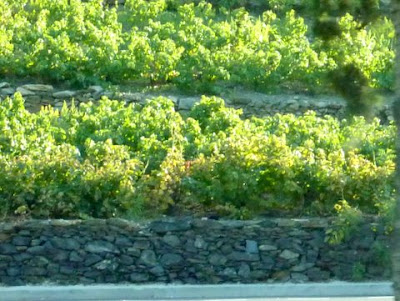
Old terraced Grenache, Banyuls-sur-mer: Vi Erickson.
I was on one of the tasting panels in Perpignan on 24th January; my table of tasters (two Spanish - erm, one Valencian, one Catalan - three French and yours truly) sampled and marked about 30 wines: one flight of Spanish rosés, one of Cannonau (my pick of those appear on my other blog - click on the link at top of page) and one of Roussillon 'table' reds. Being held in Perpignan, there were naturally a lot of local entries, which is probably reflected in the amount of medal winners from this region (and some good wines of course). Then again, most of the world's Grenache is planted in France - split between the Rhone valley, Roussillon and Languedoc - and Spain, Garnacha's spiritual home (I have/found contradictory info disagreeing over whether Spain or France has the most!).
There were also some entries from Australia (probably not as many as there could/should have been) and South Africa (again, medal winners and my favs will appear on WW.com), accompanied by surprise samples from Brazil and Republic of Macedonia! But what about California? I believe the main criterion applied for the contest was for large-majority Grenache (red, white, grey or 'furry'...) wines, which perhaps also explains the dominance of the Roussillon and lack of Chateauneuf-du-Pape or Languedoc in the 'French category', although you'd still have expected more Rhone wines in the medal line-up.
Talking of which, this is where I might make myself unpopular. I counted 163 Gold and Silver medals including nine Trophy winners: out of only 364 wines tasted, that's nearly 45% of them, which is too high a proportion compared to other international competitions; and in fact OIV regulations, the organisation that dreamed up the frankly stupid 'official' system used, apparently state that "awards are limited to 30% of samples entered..." I've come across this system before, where you have to allocate a set amount of marks to all aspects of each wine, including e.g. colour and clarity as if that really matters when making a quality judgement. Especially since Grenache isn't naturally known as a variety with lots of rich colour (you can if you really extract it), compared to say Syrah or Cabernet.
Anyway, this very long-winded methodology does at least add up to 100, but it's more generous - or the opposite - than the 100-point system used by some wine critics. Scoring works as follows: 84 to 87 Silver medal, Gold 87 to 92 and Trophy 92 to 100 (see what I mean). It's too easy to award too many or too few marks to a wine by adding them all up for each 'category' (visual, olfactory, mouthfeel, overall impression and totally subjective 'typicity'), as you're supposed to. So, I judged them applying the 'traditional' 100-pointer in my mind while asking myself: "is this really a silver or gold wine?" Then did the silly math afterwards.
Rant over: you have to use some scoring system or other obviously. And I'm certainly not knocking any attempt to promote great wines made from Grenache from around the world. The nine 'trophy' winners were as follows, which include a fair few Vins Doux Naturels fortified reds and 'whites':

Château de Péna Hors d'âge AOP Rivesaltes Tuilé, Roussillon.
Dom Brial 2010 AOP Rivesaltes Grenat, Roussillon.
Domaine Rossignol 2008 AOP Rivesaltes Ambré, Roussillon.
Albera En croisade Hors d'âge AOP Rivesaltes Ambré, Roussillon.
GT-G 2010 LePlan-Vermeersch AOP Côtes du Rhône Villages.
Lafou Els Amelers 2011 Roqueta DO Terra Alta white, Catalonia.
Saint Roch Kerbuccio 2011 Maison Lafage AOP Maury Sec, Roussillon.
Sartiglia 2011 Azienda Vinicola Attilio Contini DOC Cannonau di Sardegna (actually my top wine in our flight from Sardinia: see WW.com link at top).
Sur Grains 2011 Domaine Boudau AOP Rivesaltes Grenat, Roussillon (my note below).
The full results are viewable here: grenachesdumonde.com.

My favourites from the Roussillon and Rhone Valley (tasted in the competition blind, that evening at a food & wine tasting bash or the previous night over dinner) were as follows, including the first outing, for me at least, of some exciting Maury Sec dry red wines (the appellation rules were amended from vintage 2011 to embrace 'dry' and fortified sweet reds from the same area based on Grenache). Medals awarded are in brackets and/or my 100-point style score afterwards:
Sans plus attendre 2010, Domaine Modat Côtes du Roussillon Villages Caramany (Gold medal) - attractive white pepper, sweet cherry and liquorice; firm vs rounded with powerful yet balanced finished. 90
Domaine de Bila-Haut 2010 M. Chapoutier, Côtes du Roussillon Villages Latour de France (Gold) - young lively fruit, rich black cherry with minty spicy edges, tight fresh finish showing a bit of class too. 87+
Le Clos du Fourat 2011 L'Etoile AOP Collioure Rouge (Gold) - nice peppery style with quite rich dark fruit, rounded oak-tinged palate but has attractive tannins and ripe fruit too. 86

Cuvée Centenaire white 2010 Domaine Lafage (large proportion of Grenache blanc I believe) - shows a touch of wood layered with attractive yeast-lees notes and buttery hazelnut aromas/flavours and floral 'mineral' edges, rounded and quite soft with fair weight and rich exotic fruit vs hint of fresh acidity still; good with creamy porcini soup appetizer.
Nicolas vieilles vignes 2011 Maison Lafage, Côtes Catalanes (15% alc.) - attractive Grenache nose, sweet fruit with peppery edges and punchy mouthfeel, firm and structured with tasty ripe fruit; good (Silver).
Cuvée Léa 2011 Maison Lafage, Côtes du Roussillon Les Aspres (14%) - ripe resin-y and rich vs solid framework, closes up on its long finish; needs a little time to open up (Silver).
Montpin 2011 Domaine Pouderoux, Maury Sec - lovely Grenache fruit with peppery intensity, again tasting a bit austere on the palate at the moment (like many 2011s) but it's promising (Silver).
Légende 2011 Mas Amiel, Maury Sec - delicious juicy ripe Grenache fruit, powerful and peppery palate with tight firm long finish; very nice wine.
Grenache blanc vieilles vignes 2011 Clos des Fées (14.5%) - rich rounded and powerful, concentrated with honeyed vs aniseed flavours, rounded finish vs a touch 'mineral' too. Lovely white wine served by the owner/winemaker, the ironically philosophical and down-to-earth Henri Bizeul himself.

Vins Doux Naturels
As a 'by the way', we discovered from Eric Aracil, the Roussillon Wines' export guy who offered the first two below for tasting, that in terms of labelling "Vintage" style red VDNs, winemakers are moving to a uniform use of 'Grenat' in Rivesaltes and Maury and 'Rimage' for Banyuls.
2011 Rivesaltes Grenat 'sur grains' Domaine Boudau (fortified 'on skins', aged in inert concrete vats) - lovely lively black cherry and liquorice fruit with spicy pepper and violet notes, tasty black fruit palate vs firm tannins and nice cut, delicious style drinking well already although will improve in bottle no doubt (Trophy).
2011 Maury Mas Karolina (similar winemaking although part-aged in demi muids size casks = usually about 450 to 600 litre capacity) - more closed up to start, hints of lush dark blackberry fruit, powerful ripe and sweet with peppery tones, bigger more structured wine than above, less 'fruity' even and beginning to show more savoury characters; good stuff, for keeping.
2008 Maury Domaine Thunevin Calvet - enticing mix of dark fruity and peppery vs savoury meaty development, still has a bit of 'kick' yet is also becoming quite soft on the finish.
2010 Maury Serre Romani (15.5%) - attractive aromatic violet notes, sweet vs grippy palate, nice fresher 'lighter' style. Their 2011 won a Gold by the way.
2003 Rivesaltes ambré 2003 Vignoble de Constance et Terrassous (merger of the Thuir and Terrats co-op wineries) - delicious pecan/walnut aromas with toasted hazelnut and Amontillado-style oxidising maturing notes, well balanced and complex finish; still very much alive actually.
The day after the competition, a group of us visited Coume del Mas and Cave Abbé Rous in Banyuls-sur-mer and Domaine Sarda-Mallet on the outskirts of Perpignan: updates on these estates/wineries to follow.

Châteauneuf-du-Pape including some titbits of background presented by Michel Blanc, director of the producers' federation:
The Châteauneuf appellation area comes to about 75% Grenache overall, pruned to old bush vines which are handpicked "forcing them to sort the grapes in the vineyard or cellar." Grenache is planted up to about 150 metres altitude with less of the region's characteristic big pebbles as you go up the slopes. The vineyards are often swept by the powerful Mistral wind and see little but heavy rain when they get it. Lots of Grenache was planted here for the first time in the early 20th Century - only 30% was allowed until the end of the previous century - although "we're now looking again at our other varieties, such as Counoise, in the face of hotter summers to get better balance in the wines."

2010 Cornelia Constanza Domaine de la Solitude (100% Grenache, 10% of it aged in new oak) - aromatic floral dark cherry and liquorice nose with volatile fiery notes, punchy vs soft palate with sweet peppery fruit; attractive style even if a little 'hot'.
2010 Domaine Pierre Usseglio - lovely ripe Grenache style with liquorice and pepper, punchy vs soft and fruity palate, nice dry vs rounded tannins, quite fiery yet concentrated and complex; not over the top in the end.
2010 Grenaches de Pierre Domaine Giraud (15% alc.) - wow, quite 'hot' vs lush and spicy warm Grenache fruit; too powerful and unbalanced though: goes to show that 100% isn't necessarily best.

My pick of the Spanish rosados and Cannonau di Sardegna reds we tasted feature on WW.com (click on highlighted links), along with a few choice cuts from the succinct presentations given in the afternoon on Grenache and pen names in Sardinia, Aragon, Catalonia and Australia.

06 February 2013

World Grenache Competition part 1: Spain, Sardinia, Australia, South Africa.

The first of its kind, I/they believe (? and set to become a regular event), an international wine competition in celebration of one of my fav varieties, Grenache / Garnacha / Garnatxa / Cannonau: red, white, rosé and fortified wines. And absolutely why not, I hear you say. Ah, yes, Cannonau: it took me a while too to remember that Sardinia's Cannonau di Sardegna red is made from what they call Grenache!

05 February 2013

Film: 'Les Terroiristes du Languedoc'

I was slouched in the off-red velvet front row (stiff neck) at the packed-out Diagonal cinema in Montpellier old town recently for the premiere of American wine filmmaker (or film winemaker perhaps?!) Ken Payton's new documentary, Les Terroiristes du Languedoc. This enjoyable (although arguably half-hour too long, a little more editing needed IMHO) piece of wine storytelling follows the trials and tribulations of a dozen Languedoc wine estate owners from worries about the weather and bank manager in late spring 2012 to slight relief of vintage time of that same and somewhat unpredictable and challenging year.

04 February 2013

Alsace: Cave de Turckheim: big French co-ops part 2

Riesling Brand from
www.cave-turckheim.com
Continuing this compelling mini-mini-series on large but good French co-op wineries and their wines, which I started with this post: Rhône: Cave de Tain: big co-ops part 1... Cave de Turckheim was founded post-War and is a substantial vineyard owner in the must-tour region of Alsace nestling on France's eastern border with Germany, separated by the River Rhein yet sharing grape varieties and a long mutual history (not always a happy one) and aspects of culture (the hearty local food springs to mind).

22 January 2013

Rhône: Cave de Tain: big co-ops part 1

The sizeable Cave de Tain l'Hermitage co-operative winery dominates the 'big-boy' field in the northern Rhône Valley, although that's not necessarily a bad thing at all when you taste right across their varied range (or even just drink a glass or two of one of them, of course); including a rare back-cellar of some excellent older vintages too (e.g. 1990 red noted at bottom of page), if you're lucky enough to get the chance.

18 January 2013

Chile: no way rosé, part 4!

This latest post carries on the spirit of my slightly obsessive rosé-tinted-spectacles theme started in back 2011 (click there), exploring the perhaps contentious argument that Chile is making some of the best rosés coming out of the 'New World' or South and North America even. These two 'serious' food-demanding rosados tasting-noted below came my way recently, one bought from Marks & Spencer and the other a probably widely distributed brand from Torres.

17 January 2013

Roussillon: Domaine Les Conques, Fourques/Villemolaque

François Douville started up this not widely known estate in 2004, which encompasses 7 ha/17 acres of vines (tended organically since 2008 by the way) found on a site known as Las Counques in Catalan, reflecting this particular shape of seashell apparently. Besides vines, the pretty rolling slopes around here in Les Aspres country are home to cork oak trees (this area used to be a big production centre), woods and wild bushes with thick hedges hemming in the vineyards, where natural grass cover is left to protect the soil from erosion and help foster wildlife. Man. In 2009, François refitted some old farm buildings with a new cellar and shop, which you'll find on 2 Route de Passa in the village of Villemolaque, down the road from the family home (5 Place de la mairie, 66300 Fourques). Phone 04 6852 8256 or 06 8151 3699. francois.douville@wanadoo.fr, www.lesconques.fr.

2011 Bohême white Côtes du Roussillon (Macabeu, Grenache blanc; part-aged in barrel for a few months) – quite concentrated and nutty, intense mineral notes vs richer texture and flavour. Good+
2009 Vitis red Côtes du Roussillon (mostly Carignan plus Grenache/Syrah) – jammy and spicy nose, firm and taut mouth-feel vs subtle concentration too, attractive crunchy vs dark fruit profile with rustic edges.
2011 Vitis red - similar warm and spicy character, fruitier and less 'earthy' than the 09, again has concentrated and intense finish with crunchy vs dark fruit mix. Very good.

15 January 2013

Roussillon: Domaine Cayrol, Espira/Rivesaltes

Geographically speaking, Cayrol should really be mentioned in the same sentence as Espira de l'Agly neighbours Domaine Joliette et al, as that's where their vineyards are. But you'll find cellar and home in Rivesaltes town, so that's maybe where you're more likely to taste the wines if you're touring the area. Danièle Cayrol made their first certified organic vintage in 2011, by the way, hence this is what I tasted at last year's Millésime Bio show. More info to follow when I find some (the web address I was given doesn't work).

14 January 2013

Roussillon: Domaine de Joliette, Espira de l'Agly


Domaine de Joliette

Jean Gardiès' (update to follow soon) neighbours Philippe (pic.) and Laurence Mercier have been based in Espira for some time now – and there's a “...great-grandfather and grandfather after the war... with even older Catalan roots...” story lurking nicely in there somewhere - and Joliette is rightly a well-known name on the northern Roussillon quality circuit. Eleven vine varieties, including more whites than you might imagine in this sometimes very hot and dry microclimate and terrain, and their treasured environment have been looked after using organics since 2000. All in all, around 30 ha/75 acres make up the Joliette estate lying on the spectacular near-lunar (although a touch more wooded!) landscape nestling up near Espira and Vingrau on the edge of the Corbières hills.
Route de Vingrau, 66600 Espira de l'Agly. Phone: 04 68 64 50 60 / 06 80 33 31 44. mercier.joliette@wanadoo.fr & www.joliette-mercier.com.

2010 Côtes du Roussillon white – nutty honeyed nose, toasty and creamy palate with roasted hazelnut notes vs nice crisper 'mineral' side too. Good to very good.
2009 Côtes du Roussillon red – toasted oak tones layered with very ripe dark fruit, concentrated and grippy, closes up a little on its taut finish. Needs time.
2006 Cuvée Montpins (mostly Mourvèdre) – mix of herby, black olive and cooked cassis notes; concentrated and firm mouth-feel with savoury vs dark fruit, powerful and still youthful finish. Wow, very good.
2005 Côtes du Roussillon Villages – savoury leather aromas with minty edges too, structured and concentrated, quite extracted tannins with coconut nuances vs rich and dark texture. Good+

Languedoc: Château de Gaure part 2

The second instalment of my profile on Pierre Fabre and his dual location vineyards and wines takes us to Château de Gaure itself in the Languedoc, resting peacefully and slightly loftily between Limoux and Carcassonne, which Pierre snapped up in 2004. As I said in my report on his exciting Roussillon reds (previous post), all their vineyards are now farmed organically with minimal intervention on the winemaking front I'm told.

11 January 2013

Wine tastings in Belfast next month

There are still places left on these two Wine Education Service NI events starting early February in Belfast city centre, tutored by yours truly:
One-day wine workshop £75 for the day including lunch
'Grape to Glass' Saturday February 2
More details about this and other workshops here:
wine-education-service.co.uk/workshop

'Essential Wine Tasting' 5 week course £125 five sessions
Tuesday evenings February 5, 12, 19, 26 and March 5.
More details about this course here:
wine-education-service.co.uk/introductory
Learn about and taste wine in a fun environment: book now!
Full listing of wine tastings and courses running in Belfast Feb to June 2013 are here:
www.wine-education-service.co.uk/wine-tasting-belfast

10 January 2013

Roussillon: Château de Gaure part 1

This kind-of Roussillon estate kind of in Latour de France is actually a collection of vineyard plots spread across the varied village sites of Latour, Estagel, Calce and Cassagne; bought by Pierre Fabre who owns the real Château de Gaure (acquired in 2004) over the hills in Aude country between Limoux and Carcassonne. Drawn in by the Roussillon's rugged hypnotic charms, as many new investors and settlers are there, Pierre decided to buy and create a second vineyard bearing his name a couple of years later,

07 January 2013

France: Loire, 'old' Sancerre

Not a spotlight on cobwebbed-infested bottles of the Centre-Loire Valley's best-known dry white wine, but an intriguing vertical tasting of Sancerre ranging from a youthful seven to brooding sixteen years old (and juxtaposing a variety of very different vintages). You wouldn't usually expect anyone to talk about Sauvignon blanc wines and bottle age in the same sentence, but it just goes to show what a surprising variety Sauvignon can be. Tasting these wines, some of them wonderfully quirky rarities from top producers by the way, a few months ago now in London (although I doubt any of them has changed much since then), reminded me of some gracefully elderly New Zealand Sauvignons I once sampled; as they'd developed in the same way showing lots of intricate unexpected aromas and flavours, and how alive some of them still were/are. Commercially speaking, I imagine you'd be hard-pressed to find any of these vintages on sale of course... But, if you visited the winegrower and got on the right side of them over dinner, it's the kind of bottle they might suddenly reveal in a moment of enthusiastic conviviality (now that sounds a bit French)! More generic info on the region's wines: vins-centre-loire.comor browse around the webosphere for individual producers' sites/blogs mentioned below.


Picking at henribourgeois.com
2005 Joseph Mellot Châtellennie - 'oily' vs greengage aromas, almost Riesling like nose actually! Quite juicy and yeast-lees edged with a touch of mineral bite vs rounded with ripe kiwi fruit. Wow, still looking towards superb.
2004 Château de Sancerre / Marnier-Lapostolle - 'burnt' toasty notes, developing 'sweet' gooseberry fruit vs richer toasted side vs surprisingly fresh acidity; good and interesting wine even if that aged character vs acidity clashes a little.
2003 Domaine Fouassier Les Chailloux - ripe kiwi and quite exotic papaya type fruit, perfumed vs sweet profile; a bit weird toasty and fairly punchy (alcohol?), still has some acidity underneath though vs almost creamy texture. Odd but quite good.
2002 Pierre Prieur et Fils - developed greengage and towards toasty notes, still has very fresh acidity vs richer almost toffee like flavours; again odd but I like it! Very good.
2001 Domaine du Carrou - weird 'sweet' vs vegetal nose, ageing characters yet nicely perfumed, rounded and creamy vs crisp and mineral. A surprise, never had anything like this before! Good + perhaps.
2000 Domaine Bailly-Reverdy - I think this was a little corked, as it had musty background notes and was a bit stripped of flavour on the palate. Certainly quite rich and concentrated though.
1999 Domaine Gitton Pere et Fils - Fairly oxidised nose with Fino tones vs sweet green fruit vs toasted hazelnut; still showing a tad of freshness on the palate though, almost like old Burgundy although perhaps over the hill? Yet it's pretty long intense and interestingly quirky!
1998 André Dezat et Fils - toasty yeasty notes vs 'sweet' and rounded with pineapple vs green fruits, again it's interesting although a touch flabby in the end.
1997 Jean-Max Roger GC - much livelier than the previous two vintages, showing ageing gooseberry fruit with toasty nutty edges then crisp mouth-feel. Difficult to believe this is a 97, still has structure and freshness vs lovely maturing fruit. Very good.
1996 Domaine Henri Bourgeois La Bourgeoise - oily 'petrol-y' Riesling-esque nose, gets richer toastier and creamier in the mouth vs lively structured mouth-feel and bite. Pretty amazing really, still alive and very long. Superb.

More Centre Loire here - Pinot rosés and reds & "silex" tasting...

RED

'Red is for wine, blood, revolution, colour... Time-warped slices of mystery, history, fantasy, crime, art, cinema and love...' Buy the e-book or paperback novel on Amazon.co.uk or Amazon.com. Click here to view the RED blog!